
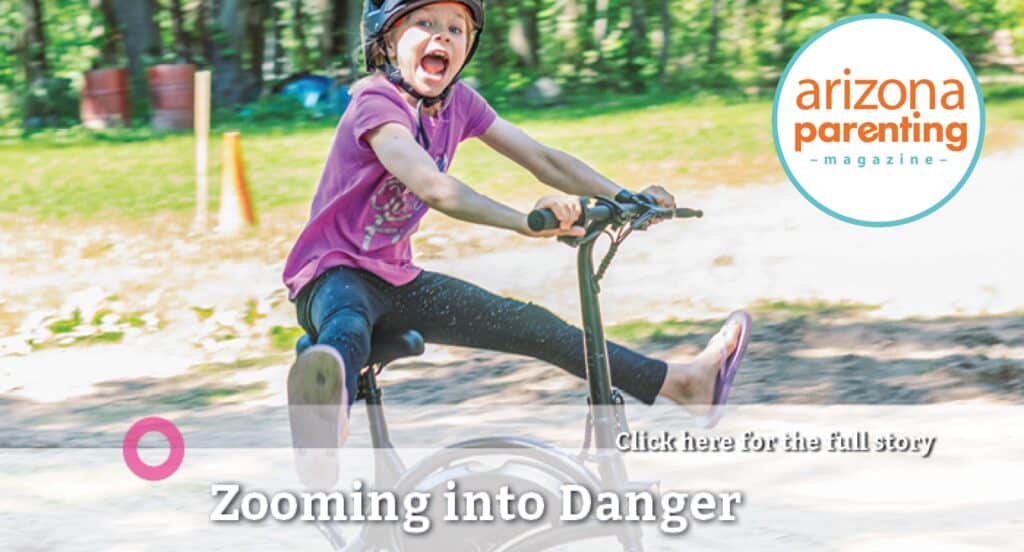
Zooming Into Danger? How to Keep Your Child Safe on an E-Bike
By Dr. Michael White, Chief Clinical Officer at Valleywise Health
It is hard to walk near a school or through a Valley neighborhood without seeing young riders zooming by on e-bikes. For children and teenagers, battery-powered bikes and scooters are incredibly attractive – they offer independence and a coolness factor, allowing them to zip around with minimal effort.
But with speeds reaching up to 28 miles per hour, they are also incredibly dangerous. Emergency departments across the US are reporting increasing numbers of injuries, including serious head trauma, linked to e-bike crashes.
You’ve either witnessed it firsthand or seen the social medica clips – teens without helmets on e-bikes popping wheelies, weaving through traffic of doubling up passengers.
Parents often don’t realize how powerful these machines are – or how minors are unprepared to handle one safely. Consider:
- One-third of e-bike and scooter injuries occur in children 14 and younger, according to the US Consumer Product Safety Commission.
- Over 20,000 people are injured while riding e-bikes annually, with approximately 3,000 individuals requiring hospitalization, according to the American College of Surgeons.
Why think twice about e-bikes
Unlike traditional bicycles, e-bikes are faster and heavier, which means that the consequences of a crash are more severe. Accidents often involve serious head injuries, broken bones, lacerations or worse.
Arizona state law allows local jurisdictions to set specific rules for electric bikes and scooters, and cities like Phoenix, Scottsdale and Tempe have taken steps to restrict e-bike use by minors. In Phoenix, you must be 16 or older to ride an e-bike or e-scooter. In Scottsdale, individuals under 16 are prohibited from riding Class 3 e-bikes or electric motorcycles on city property, including streets and paths.
Keeping kids safe on motorized vehicles
If you do opt for an e-bike for your kids, setting boundaries is critical.
- Many pediatric experts recommend waiting until 14-16 years old, and urge parents to set clear riding zones, such as quiet neighborhoods, parks and bike paths, and prohibit riding in traffic.
- Most importantly, wearing a helmet is non-negotiable. They significantly reduce head injury risk. Also, encourage the use of gloves, knee/elbow pads and reflective vests.
- Stick with Class 1 and 2 e-bikes which run up to 20 miles an hour. Faster Class 3 e-bikes top out at 28 miles an hour and are much riskier.
- Finally, teach kids the rules of the road and instill “defensive driving” in young riders. It might just save them a visit to the emergency department.
Michael White, MD, joined Valleywise Health as Executive Vice President, Chief Clinical Officer in August 2019. In his role, Dr. White works to advance the mission, vision, and values of Valleywise Health to improve clinical outcomes, enhance patient experience, and grow key programs.
Published in Arizona Parenting Magazine, October 2025